Why a career in tech?
I’ve always loved science for two very different reasons: the reassuring rigour of logic on one side, and the bit of creativity, even luck, that leads to real discoveries, once you find the right experiment. What fascinates me about tech is that it holds both of these in tension: the long time of discovery or prototyping, then the shift in scale. It moves so fast that you have to anticipate, build languages for machines that don’t exist yet.
Your professional experience?
After my baccalauréat, I went into a biology preparatory class (BCPST), partly because I loved it, partly because it felt like there was still more to formalise than in fields like physics or chemistry, and also on some good advice, to be in a slightly less “adversarial” environment than the maths-physics track, regardless of my own skills. But I missed maths, and I managed to get into the École Normale Supérieure, drawn by the promise of real freedom in choosing my path. I took several courses in the computer science department, then took a gap year to properly move into machine learning, so I could really understand both worlds and sit at their interface. I then did a PhD at the École des Mines and the Institut Curie, looking for methods to better understand the genome of cancers and how it evolves, hoping this might point to therapeutic leads. I then discovered the secondary use of care data, which offers less spectacular adjustments as an entirely new treatment, but ones that can be put into practice much faster to improve patient care.
Your first experience with technology?
I took a gap year after my first year of a biology Master’s to focus properly on maths and computer science, and spent the whole year working at a startup, tinyclues, which used machine learning for marketing. A bit far from what had originally drawn me in, but at the time it was one of the very few fields where AI was actually profitable. I learned machine learning by applying it to very rich data, and picked up good practices for building industrial code collaboratively, in the exciting environment of the “Silicon Sentier”. I could see that this was really where things were happening, right then, and it convinced me to do a Master’s in statistical learning rather than bioinformatics, shifting my path gradually.
What do you do today, and why?
Today, I’m a researcher in AI applied to health. I develop machine learning methods to extract relevant medical knowledge from data collected through care, or through reimbursement for that care.
Medical practice partly relies on clinical trials and research cohorts, but these never cover every real-world case, and many decisions also rest on expert recommendations, or even on habits specific to a given team or doctor, simply because no study has settled the question. The digitisation of medical records opens up a complementary path: observing these practices at scale, to identify, within all that variability, the care pathways that work best for a given patient’s profile. My goal isn’t just to predict what will happen to a patient, but to understand what, in their care pathway, actually caused an improvement or a decline in their condition. That’s a causal question, far more demanding than a simple correlation.
This calls for new AI tools, able to work with real-life data that are not collected specifically for research, nor exhaustive or neatly structured, at the scale of millions of patients, with computing resources constrained by how sensitive the data is: it can’t leave hospital infrastructure.
But a powerful model or a large dataset are not enough on their own: the quality of the answer depends above all on asking the right question, and on the rigor with which every analytical choice is made. That’s why I work closely with medical doctors from each relevant specialty, as well as with epidemiologists. We’re a long way from the paradigm where a bigger model, fed with more data, would automatically give a better answer.
Your strengths in this role?
My dual background in biology and maths/computer science is key in my day-to-day work, letting me interact effectively with everyone involved in a project. And the curiosity I bring to every stage, even the ones that seem unglamorous, is what lets me keep going over several years, and above all, what helps inspire the people I supervise to follow me on that journey, because this is, first and foremost, teamwork.
Past challenges, failures and disappointments?
I was removed from my first PhD project. Hard at the time, but I had a lot of support from one of my PhD supervisors to bounce back and build on other analyses I had started in parallel. What I take from that episode is that interdisciplinary work demands a lot of patience, and above all very clear communication about everyone’s expectations, as we don’t always share the same priorities.
Best moments, successes you’re proud of?
My PhD defense! That’s the moment my family and friends realized I really had mastered what I was doing, and that I trusted myself, my abilities, my work. My way of doing science leans heavily on doubt, and a perhaps too visible awareness that there are many ways to do things, and mine isn’t necessarily the best one.
People who helped, influenced -or made your life difficult?
I’ve had a lot of encouragement, advice, and recommendations at key moments, and a few less kind encounters — but those people don’t deserve any more of my time! First of all, my mother, who showed me every day just how much she thrived in her work, and that science studies or positions of responsibility were absolutely not off-limits to women (she went to École Polytechnique), even with three children, even with a serious illness.
Some teachers were absolutely key to how my path unfolded: Benoît Corn, who advised me toward a biology prep track with great insight, never once questioning my abilities, only what would make me happy; Farouk Boucekkine, who gave me extra maths challenges and warmly recommended me; David Bessis and Olivier Hervieu, who trusted me to join tinyclues as a data scientist when I knew nothing about machine learning and barely spoke during the interview out of shyness. And of course Jean-Philippe Vert and the RT2 Lab at the Institut Curie, who supported me through my PhD and its twists and turns, helping me find a good question, and learn to ask many more. And finally my father, Julie Josse, Bertrand Thirion and Gaël Varoquaux, for this last transition toward independent research.
Today, I have a very supportive circle around me, including my sisters, my husband, my daughters, my uncles and aunts, my cousins.
Your hopes and future challenges?
Finding a good balance between my deeper methodological projects and applied work. The collaborative side of applied projects brings a lot of energy, with exchanges and ideas crossing paths. Carving out time for deeper, more focused thinking takes discipline, and learning to say no!
What do you do when you don’t work?
I spend a lot of time in the countryside, and even in Paris, if I get the chance to take a video call in a garden rather than indoors, it lights up my whole day! I also spend a lot of time with my daughters; we do a lot of hands-on activities together: if the thing we want doesn’t exist, we just build it!
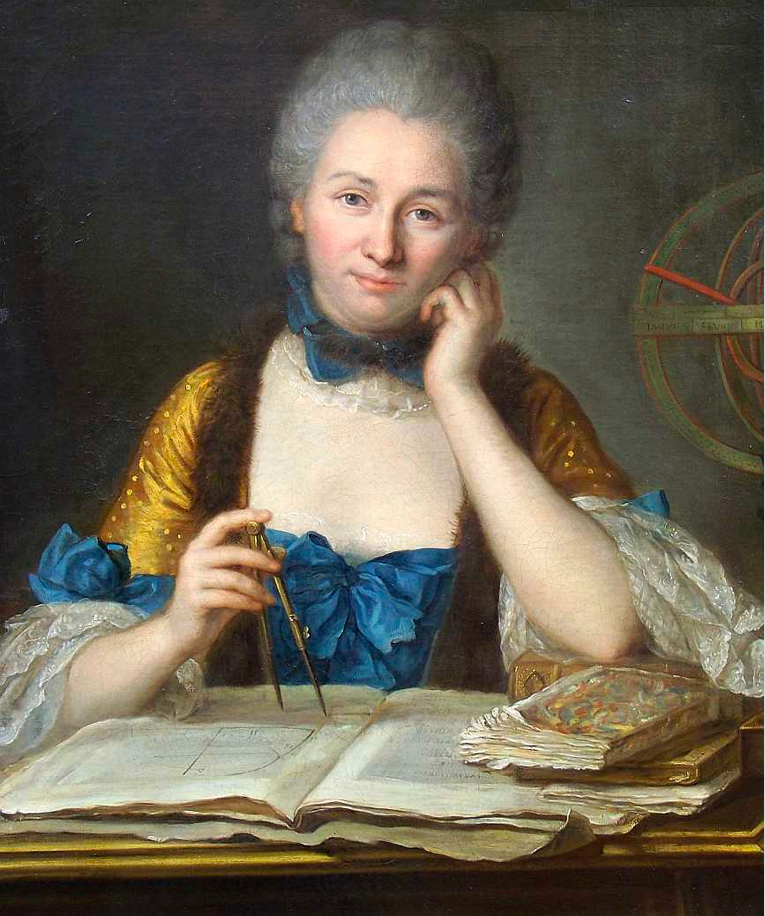
Your heroes -from History or fiction?
Elle Woods in “Legally Blonde”: she sets herself a goal everyone thinks she’s incapable of, and she gets there, but without playing by the usual rules. She manages to turn everything she knows, even the things that seem irrelevant at first glance, into real assets.
A saying or proverb you like in particular?
“Help yourself, and heaven will help you”. Nothing to do with religion for me, more a reminder that if I give the first push, a lot of things can start moving; an encouragement I repeat to myself often, to keep going through difficulties.
A book to take with you on a desert island?
Balzac’s La Comédie humaine. It’s a work I keep coming back to, and I always get so absorbed in it that I miss my metro stop. Looking at it with a researcher’s eye, I think it’s a remarkably good digital twin of society, and a lot of the mechanisms at play still hold true in today’s world.
A message to young female professionals?
It’s a bit of a contradiction: aiming high opens a huge number of doors, and it really helps to have the stamp of a top school to prove you genuinely deserve a seat at the table — but you also need to know when to take a different path if the environment turns out too hostile. Don’t hesitate to try several doors, because you’ll get a lot of ‘no’s, or even no answer at all; ask for advice along the way to check you’re heading in the right direction!
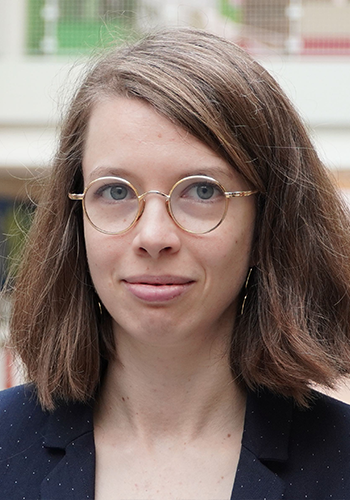
Photo credit: Inria